If I could offer other entrepreneurs one bit of advice, it would be that it’s really important to understand who you're working with and to invest in good and trusted relationships.
- Jonathan Hirsch, Paradigm Health
The average time to get new therapeutics to market is measured in decades because barriers are deeply rooted and prohibitively high. While understanding of the connections between human biology, genetics, and phenotype is advancing rapidly, the processes of developing treatments and moving them to approval remain constrained by manual tasks that pervade trial design, trial administration and regulatory oversight. Patients are dying because we can’t efficiently and effectively connect this advancing knowledge of disease to the people who need it.
In a recent New York Times guest essay, The Search for New Cures Is Broken, Ruxandra Teslo argues that the central obstacle to new cancer treatments is no longer the science itself. It is the US capacity to test discoveries in people. The cost of generating the evidence required to open a Phase 1 trial in the United States has doubled on average since 2017, she writes, and complex therapies can cost several million dollars per patient. Trials that could create the next round of scientific learning are delayed, abandoned, or moved abroad, leaving American patients with fewer opportunities to participate.
That bottleneck is tightening just as AI is dramatically accelerating compound discovery and reducing the cost of screening and synthesis. Billions of dollars are being saved, and thousands of potentially viable candidates are being identified each year. But downstream trial processes have not kept pace. Provider, patient, and site matching remains ineffective. As much as 20% of a trial's duration is consumed by the dead time of setup, contracting, and administration required by regulation. In Australia, Phase 1 trials can begin 6 to 12 months faster without a notable increase in adverse safety events, proving that reform can allow the United States to both preserve safety and move faster in clinical trials. The task now is to build the infrastructure that makes that possible at scale.
AI is advancing “upstream” drug discovery processes. Can we also utilize AI-related technologies to improve “downstream” processes and activities required to get new treatments to patients? What’s the potential for an “AI-first” platform for clinical trials and regulatory approval?
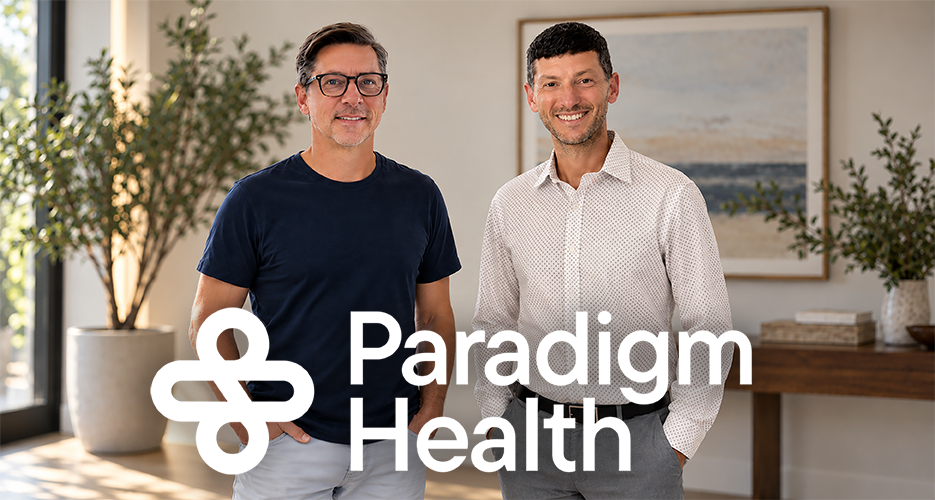
Kent Thoelke, CEO, and Jonathan Hirsch, chief strategy and growth officer, founded Paradigm Health to accelerate and improve the processes for moving medical discoveries into clinical trials, so that patients can access new treatment options faster.
“Trials are manual. They take a ton of time. They’re incredibly complicated. Everything about a trial takes longer, costs more, and fosters gross inefficiencies,” said Hirsch. “The North Star is applying technology to accelerate access to new therapies by making trials more efficient and effective for providers, patients, and regulators. “
Reaching that North Star requires deep understanding of the problem and industry dynamics, as well as where AI can help. Throwing general AI models at a domain with profound privacy, data quality, liability, and life-and-death concerns won’t work. It requires creating and diffusing multiple classes of complex innovation into a risk-averse marketplace.
Q: Every founder has a founding. Tell me about your early years.
Kent: I was a biochemistry major. My plan was to work in a research lab doing science-y things. But after working in a lab for a few years, I realized it wasn’t for me. Too sterile. Lots of time spent with concepts, not enough meaningful interactions with people. Eventually, I found myself doing clinical research at Baxter in the early 1990s, when clinical research disciplines were relatively new. Clinical research was much more aligned with my interests because it combined science and people and – occasionally – exhilarating results. I mean, you could see the direct and specific impacts that breakthrough drugs were having on people. For example, I was part of a clinical research project that studied bone marrow transplants. These are some of the sickest patients. The trial showed that the procedure didn’t cure everyone, but it cured many who otherwise would have died. I decided that I was doing something meaningful and wanted to keep doing it.
Jonathan: I always wanted to be an entrepreneur. My grandpa started selling metal shower doors on the Lower East Side of Manhattan. He figured out that a metal shower door frame might make a good picture frame and started a company to make affordable metal picture frames. If you bought a metal picture frame from Bed Bath & Beyond in the 1990s, you took home my childhood pictures as stock photos. Of course, that doesn’t naturally lead me to Paradigm Health. My dad and my uncle both ended up in medical science fields, my dad as a physician, my uncle as a PhD neuroscientist. When I was growing up, I had opportunities to see both close up: entrepreneurship and lab work. I went to school studying neuroscience, and ultimately, I decided I wanted to focus on entrepreneurship in the medical field, blending both to help patients at scale.
Q: What did you see in each other that led you to jointly start Paradigm Health?
Kent: I spent most of my career in the contract research organization (CRO) space. I rose to be chief science officer at PRA Health Sciences. I really enjoyed that job, but we were acquired and in the ensuing shuffle I ended up as CIO of the combined company. Not particularly interesting to me. About that time, I started getting calls from investors interested in exploring how best to accelerate and improve the clinical trial processes of drug development. That was a problem space and market I knew really well, but I also knew that any solution would require deep technology expertise. I had a strong technology background, but I knew that there was outstanding talent out there that could go much deeper than I could.
Jonathan: I had a good friend, and it turned out he and his husband were very close friends with Kent. They knew our mutual interests and suggested we meet. They invited Kent to an LGBTQ networking event at a JP Morgan Healthcare conference. We chatted very briefly and went our separate ways.
Two years later, I’m incubating a company in this space and I’m putting together a list of folks that I think would be great to work with. Remembering our conversation at JP Morgan, I put Kent on that list. I reached out to several venture capitalists to get their feedback on what I’m doing and one of them tells me that ARCH is working on a company in the space and they just brought in a guy to lead it. Who? It’s Kent! Kent and I jump on a call to chat, we agree to keep talking after a vacation I was taking to Southern California, and it turns out that he lives a few blocks from where I’ll be staying! The two of us met up in person, went for a bunch of walks, and decided to combine efforts. Very serendipitous.
Kent: Serendipity played a role, for sure, but we connected pretty deeply on a number of fronts. For example, Jonathan told me about a bunch of work he did in the glioblastoma space; my dad died of a glioblastoma. We identified areas where we approach the world and business differently – I mean, that’s an essential part of creating a strong partnership – but we found, most importantly, that we shared in common a desire to take care of humans by doggedly fixing areas where the health industry was letting people down. Ultimately, I end up a bit higher on the empathy side; Jonathan on the analytic side. We balance each other really, really well.
Jonathan: That issue of balance is very important in our world. We know we must operate and address a highly regulated market that serves life-and-death needs. Sometimes things must be done in a certain way. But we also must push an innovative mindset that questions things, challenges assumptions, and finds opportunities to rip it up, tear it down, and rebuild. Together, we’ve mastered that balancing act. We’re agile enough to change Paradigm Health in response to market conditions.
Still, we together saw very early on what our strategy was. First, use technology to replace manual labor in clinical trial processes. Second, embed the platform in health provider organizations to make their operations more efficient. Third, demonstrate the efficiency improvements – without loss of trial fidelity – to pharmaceutical companies so that they deploy the platform to ramp up the number of trials. That strategic touchstone hasn’t changed one iota.
Q: Your mission statement is compelling: To accelerate access to new therapies for everybody by making trials more efficient, effective, and inclusive. And your strategy is clear. But you have to translate that vision into a sustainable business. What moats, as Warren Buffet might say, are you creating to defend your market leadership?
Jonathan: We have three types of moats; each tied to a thrust of our strategy. A technology moat, a provider partner moat, and an execution and delivery moat. There’s a fourth moat, of sorts, that Kent should discuss.
The technology moat starts with the deep domain expertise within Paradigm Health and our ability to turn that into advanced software. Building software may be getting easier, but what remains really hard is to build software that is validated, trained, and customizable in health industry markets. Our product understands medicine, biology, medical workflows, and clinical trial operations and can run at any scale. We did it by building our own internal AI stack. That includes our own model wrappers and model routing architecture so that we're able to control our own destiny as foundation models change. It also includes our own agentic orchestration layer, which helped us construct what effectively is our own clinical training and clinical intelligence layers. Basically, we’ve incorporated and embedded medical reasoning and clinical reasoning into our agentic layer.
When I’m talking about the second moat, the provider partner moat, what I’m really talking about is this: We have one of the largest, technology-deployed health service provider networks for operating clinical research in the world. All our provider partners are deployed on consistent software. The workflows are all bespoke for each provider partner, but all are orchestrated utilizing our software. That’s a very wide, very deep moat. Lining up that provider network was only possible to construct because of the deep industry knowledge and relationships we have.
The third moat is our capacity for execution and delivery with big pharma clients. We know what we do, we know how to do it better than anyone else in our space, and we do it better every time we do it. It’s very difficult to become an enterprise-qualified vendor for a big pharma company. It takes years to get through vendor qualification and contracting before you can run your first pilot and prove your competence and build your track record. We did it as a startup because we had the technology, people, and execution discipline to do it.
Kent: Yeah, so I guess you could call our research collaboration with the FDA a fourth moat. The biotech/pharma industry suffers from massive amounts of status quo paralysis. They have done things the same way for 35 years. The biggest change made in clinical trials in the last couple of decades was transitioning from paper data collection of clinical trial information to electronic data capture, which was just taking paper forms and making it possible to fill them out on the computer. I guess we took awful physician handwriting out of the equation, which probably improved efficiency and quality, but… Hold on. I have to be the nimble startup CEO for a second. Jonathan, why don’t you pick this up.
Jonathan: Sure. The FDA doesn’t operate in a vacuum. Nor do international agencies that fill the same function in other countries. They are fully aware of the impact of inefficiencies and inequities in the clinical trial world. We noted that the FDA for more than a decade had been publicly signaling that they wanted to embrace more technology-forward approaches to clinical trials. But the FDA can’t necessarily mandate those kinds of changes. They can create the regulatory environment for something new to be tried. But that “something” can’t just be conceptual; it must be implementable.
So, the FDA started looking for people and institutions to work with to do a demonstration project that used technology to speed up the clinical trial process. They started their search with the usual suspects, all the biggest companies in healthcare technology, but our understanding is that none could deliver a viable demonstration. We weren’t on the FDA’s radar, but one of our happiest big pharma company customers was. When the FDA asked our customer if there was anyone else they should talk to, they pointed the FDA to Paradigm Health.
One thing leads to another and over the New Year’s holiday of 2025 into 2026, we jump into action. It’s the nimble startup story. We scope out a collaboration agreement with the FDA, get it signed, and quickly do a proof-of-concept demonstration with them. The demonstration is a big success and we secure a research collaboration agreement that turns into the “FDA Real-Time Clinical Trials Initiative.” The FDA made a big announcement and made us part of a larger initiative to modernize clinical trials. And that allowed us to signal to the pharma companies that, "Yes, it is okay to embrace this new technology approach; even the FDA has embraced it." You might not call it a “moat” in the traditional sense, but it certainly gives us a crucial leg up in the market.
Kent: Jonathan is exactly right. The FDA engagement certainly enhanced our credibility with pharma. When the real-time clinical trials announcement came out, it stimulated enormous industry engagement, conversation, and support. Everyone now had common, practical concepts and a language for discussing the problem and the solution. There’s still a lot of very tricky change management required, but I'm thrilled that we happen to be the backbone for making that change.
Ultimately, the advent of AI and large language models (LLMs) has dramatically changed the clinical trials and drug approval solution space. LLMs offer tremendous potential for making trials dramatically more mutable and speedy, without compromising science quality and regulatory integrity. Actually, I’d say while improving quality and integrity – if done right. Ultimately, that’s at the core of each of our moats.
Q: That’s exciting! If I may, I’d like to dive deeper into one of the moats you mentioned. I’d like to learn more about your use of AI.
Jonathan: As one example, we've built what we call an “agentic memory layer.” Our software uses this layer to store and remember everything about how a user interacts with the system, including sources of data and how that source data manifests. Consequently, as our users engage our software, they train the software with skills unique to their use that allows the software to perform functions on their behalf more efficiently – again, without compromising the fidelity of these enormously complex trial processes. We plan to publish a paper about our agentic memory soon, but our agentic memory feature is a big function in our technology moat.
Q: Paradigm Health is a unique company that requires unique leadership. Describe your approach and team.
Kent: We're a startup of roughly 160 people. Together, we’re building a phenomenal new class of product that is massively changing an incredibly important industry. We know we face major challenges and yet must accelerate our impact. That’s not just a statement about the capital or competitive environment. As I said before, we’re constantly reinforcing our mission: make clinical trial and drug approval processes more efficient, effective, and inclusive. That’s a statement about improving the lives of everyone and galvanizes everyone here. But it takes a special person to want to work under this set of constraints and goals. We think a lot about our employees because we know we have to put our employees first in a high-pressure environment.
Jonathan and I have been working together for five years. We’ve recruited an outstanding executive team that has gelled over the last three years or so. We do a really good job of collaboratively running the company. I mean, we're too small to say, "That's not my job." Across the board, we all are involved in running the company, and I think that works really well for us now. Of course, as we continue to scale and get larger and larger, we’ll attract additional domain expertise, but we have the opportunity, strategy, and – perhaps most importantly – an existing team capable of attracting the best.
Jonathan: Kent nailed the leadership challenge. I’d add one thing. We need to attract a particular type of entrepreneurial team member. We hire entrepreneurial team members who are mission-driven. Kent and I have worked hard, very hard, to define our problem domain, establish our mission, and forge our strategy. Our team members come here first and foremost to attack the mission, because it’s really important.
Frankly, that's part of why we wanted to work with DFJ Growth. I’ve known Justin Kao, our DFJ Growth partner, for, like, 15 years. When Kent and I started, one other area of alignment was that we knew we were going to be a mission-driven company. When we went out for capital, we knew we needed to find investors who are both mission-driven and can help us keep a close eye on financial goals. We’ve got that with DFJ Growth. If I could offer other entrepreneurs one bit of advice, it would be that it’s really important to understand who you're working with and to invest in good and trusted relationships.
Q: That’s so important. One more question: Looking out 10 years, what success story do you want Paradigm Health to be able to tell?
Kent: Jonathan, go first. I'll be interested to hear what you say.
Jonathan: I think that 10 years out, the North Star measure of success for us is the number of medicines that were accelerated through approval into patients' hands and the number of lives that acceleration impacted. If we can declare success on that, we will have built a massive, meaningful business. Everything else derives from that.
Kent: Yeah, the scale piece – Jonathan said “massive” – is super important. We’ve talked a lot about being mission-driven, and we are. But we know that the market impact everybody wants – faster access to superior, life-saving therapies – won’t accrue through a highly diverse and inconsistent patchwork of approaches. That won’t be much of a solution. We want to make sure that we are providing the core technology powering the majority of engagements across healthcare systems in clinical trials and therapy approval processes. That’s partly why scale is so very important. The way we get more medicines to market is to get more trials through the system. The way that we do that is all about scaling Paradigm Health. Leading the industry in the deployment of this crucial technology that improves health outcomes is key.