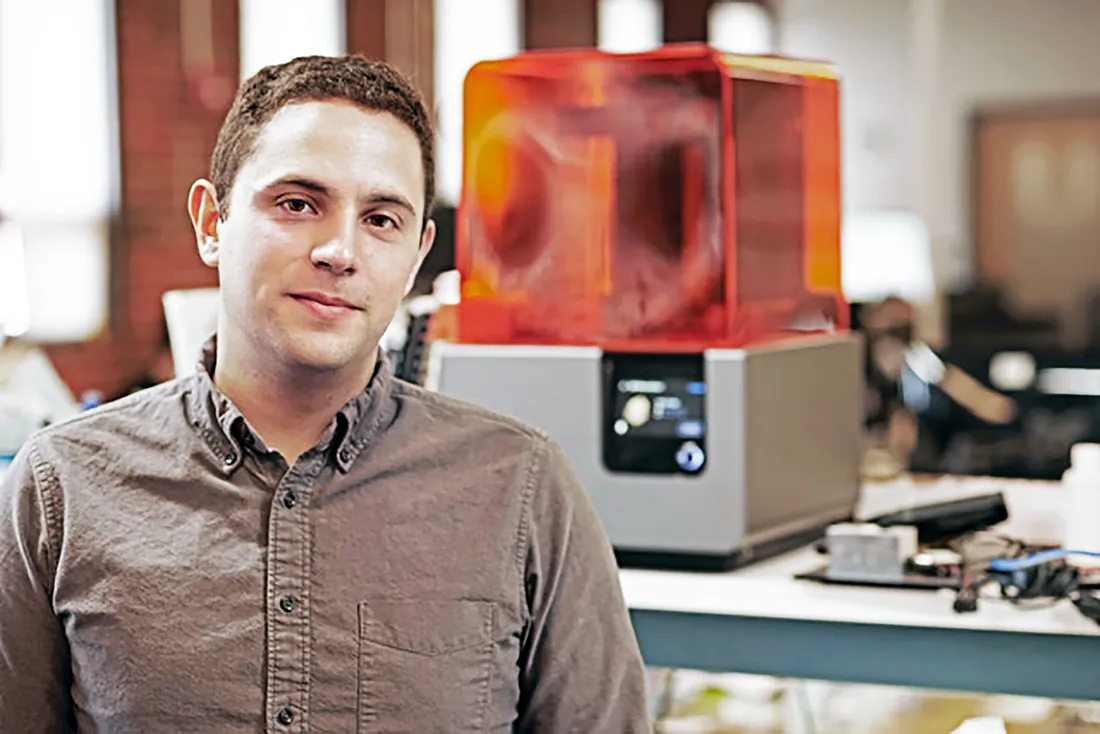
I find myself thinking about how to better organize people, thinking about what motivates them and how to break up big problems into pieces so that people can get things done.
When Maxim Lobovsky started Formlabs in a Cambridge basement in 2011, he and his two co-founders hoped to realize their vision of expanding access to digital fabrication, so that anyone could essentially make anything. His company’s 3D printers have since made good on that vision with about 60 million parts rolling off their machines.
From Hollywood to engineering to healthcare — basically any industry that uses plastic — Formlabs has helped disrupt an industry where powerful 3D printing technology used to cost around $100,000 and required a staff of full-time technicians. Companies can now deploy that kind of advanced functionality on a desktop machine selling for around $3,000.
“It has been a long road and we’re only a few steps in,” said Lobovsky.
Q : Where did you grow up?
New Providence, New Jersey. A suburb of New York City.
Q: And both your parents are immigrants?
My parents moved here from Ukraine, when it was still part of the Soviet Union. My mom arrived with her family at 17. My dad was 25 when he left the USSR, but he had to go through Israel at the time without his parents. Then he had to figure out whether he would go to the US, Canada, or Australia. Those were just places that he had read about. He didn’t know anything about them and had one shot. Essentially, you had to pick the place to move to. I guess he chose well.
Q: How did their immigrant experience rub off on you?
I’ve seen statistics that something like two-thirds of successful entrepreneurs in the US are either first or second-generation immigrants. I think it’s because those are people who came from places where it was hard to live and came here because they wanted to change their lives. I grew up within a Russian-Jewish culture that certainly valued hard work and education to a huge degree. So, their example definitely had a formative impact on me.
Q: Did it also impact your choice down the road to become an entrepreneur?
Definitely. My parents were grateful for the opportunity they were given in America. Both became engineers. My dad worked at Honeywell while my mom was at Bell Labs. Looking back, I was appreciative of the opportunities that I would not otherwise have had and learned not to take things for granted — or to expect that anyone is going to provide you with things. I also listened while my parents, especially my dad, would express their frustration with big companies. But after he got laid off after many years with Honeywell, he decided to go out on his own as a consultant. I was 14 or 15 at the time and remember arguing with him, saying he couldn’t do this without a big company behind you. And he said, “No, I can do it.” And he was right. In fact, he spent the rest of his career working on his own and was much happier. That was definitely a big inspiration.
Q: When you were younger, did you have any ideas about what you’d like to do with your life?
When I was really young, I wanted to become a fighter pilot. Then I settled on wanting to be a physicist.
Q: Well, you batted one for two. You did get into the applied physics program at Cornell. But did you change your plans?
I think I figured out that I wasn’t quite going to excel in physics and didn’t think there would be much point in being a second-rate academic. And as I got more advanced in physics, I realized that I wanted to do something a bit more practical.
Q: What sparked your interest in 3D printing?
Back in high school, we had a robotics program and that was a pretty awesome experience for me to learn about practical engineering. And then, when my dad worked at Honeywell, he was working with some of the first 3D printers in the world and tried to explain this very powerful technology. I didn’t totally get it at the time, but I was interested.
Later, when I studied at Cornell, there was an open-source 3D printer project and it really brought home for me this idea of making them cheaper and easier to use. I just found the idea inspiring. There were exciting ideas at the time about desktop 3D printers and I thought about trying to commercialize them.
Q: But you didn’t decide at that point to start a company after graduating?
I realized that I wasn’t ready — or didn’t know what to do — so I didn’t try to start a company then. I’m sure I would’ve failed. I probably would’ve stayed at Cornell except that my girlfriend at the time lived in Boston. So, I went to MIT for post-grad — making me the only person I know who went to MIT for a girl.
Q: That turned out to be fortunate. That’s where you met David Cranor and Natan Linder, the guys who later became your co-founders.
That’s right. My plan was to get a PhD, but I was getting burned out. There weren’t many real jobs around that I would have liked. So, it was from a point of desperation that I was like, `I guess I need to start my own thing because I’ve got nothing else that I want to do’ and so I came back to this idea of desktop 3D printers. I had some variations on the idea that I thought were unique and valuable. Meanwhile, there was this great “maker culture” at the Media Lab where people were making stuff at all hours of the day and everyone was talking and thinking about these things all the time. I first met David and Natan in a class called “How to Make Almost Anything,” which was all about digital fabrication tools. I started working on a prototype based on the idea with David, who by that time was my roommate. And Natan had experience with entrepreneurship and fundraising, and it was clear we should take some of his advice on how to raise money and that was how we started.
Q: So, in the decade since Formlabs first opened its doors, what have you learned about yourself as a manager and as a leader?
That’s an interesting question. I’ve learned that I’m less of an introvert than I used to think I was. Now I know that I’m probably somewhere in the middle of the spectrum, at least amongst my more introverted friends who I’m around. And I actually enjoy winning people over. That’s something I didn’t know that I would like to do. I don’t know whether I’d say that I’m good at it in a general sense, but I do have a unique approach that works while telling our story and getting people excited about it. And as I spend more time learning and thinking about management, here’s another thing that I wouldn’t have thought that I might care so much about: I find myself thinking about how to better organize people, thinking about what motivates them and how to break up big problems into pieces so that people can get things done.
Q: I think you may be the first 3D printer maker that featured in an Oscar-winning selection. Any idea whether Formlabs has many Hollywood customers?
Oh yeah, tons. I think our products have been involved in the production of essentially every major, big-budget Hollywood movie. We are in all of the studios — Dreamworks, Pixar — and our printers have also appeared in TV shows.
Q: Speaking of Hollywood, do you have a favorite film?
Stanley Kubrick’s Barry Lyndon. It’s one of my favorite movies of all time.
Q: If you were isolated for a period and could bring along only one book for the duration, what would that be?
One Hundred Years of Solitude by Gabriel García Márquez.
Q: Do you have a favorite quote or motto?
It’s from Shakespeare: A peace above all earthly dignities, a still and quiet conscience.
Q: Is there an individual or individuals who you really admire?
I’m definitely in the Elon Musk fan club.
Q: Last question, given that you grew up in a house with two parents from Ukraine, did you learn to make at least a few decent East European dishes?
Well, I do make my mom’s borscht a few times each winter and can cook syrniki, these little cheese pancakes that they eat.