
When large language models (LLMs) burst onto the scene in late 2022, nobody quite knew how to develop applications with them. In stepped Harrison Chase and Ankush Gola with LangChain – an open-source framework for building with LLMs. Within a year, LangChain crossed 70,000 GitHub stars and became the de facto starting point for developers, allowing them to chain together prompts, connect external tools, and ground responses in trusted data. Our thesis at the time was that the LLM “brain” was just one component of a broader system required for delivering useful outcomes. We believed there was an opportunity to power the end-to-end AI development lifecycle and that LangChain was in a unique position to do so, but the market was still nascent.
Fast-forward four years: agents – systems that use AI models, context, and tools to complete end-to-end tasks – have hit a tipping point. Consumer agents are booking reservations and managing calendars, while enterprise agents are starting to deliver significant productivity gains in accounting, legal, sales, and marketing. AI is now a top priority for technology leaders, but getting an agent deployed remains a major and ongoing challenge. As businesses delegate more work to agents, owning a reliable system for running, improving, and governing them becomes a competitive advantage.
Enterprises and AI-native companies are increasingly turning to LangChain for this infrastructure. We’re thrilled to support LangChain in its $300 million Series C and partner with the team as they advance their mission: to enable every company to own its own intelligence.
Developing agents requires a fundamentally different approach from legacy software development. An agent’s behavior emerges from the interaction between the model, the harness around it, the context it receives, and the tools it can use. When something goes wrong, the cause may lie in any of those components or in how they work together. With new models and capabilities arriving constantly, getting an agent into production begins an ongoing process of testing, observing, and refining its behavior. At the center of this process are evaluations (tests that measure performance on defined tasks) and traces (step-by-step records of an agent’s actions and results). Together, they help teams diagnose failures, compare implementations, and determine whether a change should go live.
Looking forward, we believe businesses will use both agents they build internally and third-party agents, powered by frontier, open-source, and fine-tuned models. Much of their value will come from applying those models to proprietary data, workflows, and process knowledge that set each enterprise apart. To capture that value, companies need the flexibility to choose their models, control their data and infrastructure, and continuously improve their agents while maintaining the governance to operate securely at scale. Through repeated deployments, companies accumulate valuable records of what succeeds, what fails, and where human judgment is still required. These learnings become an asset that compounds over time, even as the underlying models and tools change. LangSmith, LangChain’s platform for testing, deploying, and monitoring AI agents, gives businesses the means to own their agent systems.
Since we first met, the team has expanded LangChain from its open-source roots into a platform supporting the full agent development lifecycle. LangChain’s open-source harnesses give developers control over agent architecture, while LangSmith provides the infrastructure to deploy agents reliably at scale, monitor and evaluate their performance, and govern how they access models, tools, and data. LangSmith Engine takes this further by automatically analyzing agent behavior, identifying failures, and proposing changes for review. Companies are already seeing the impact. Workday uses LangSmith to run and govern agents across its organization, reducing the time to deploy a new agent from five months to under a day. Clay uses LangSmith to monitor hundreds of millions of agent runs per month, continuously improving how its agents research prospects, qualify leads, and tailor sales outreach.
We believe this is just the beginning. Agent engineering is becoming a core enterprise function, and LangChain is defining the category.
Throughout the last four years, Harrison, Ankush, and the team have helped shape how AI agents are built, tested, and deployed. They combine technical depth and foresight with a close understanding of developers’ needs – and have repeatedly turned that into foundational products for the enterprise. Every business will want to own its intelligence, and LangChain is building the infrastructure to power that future.
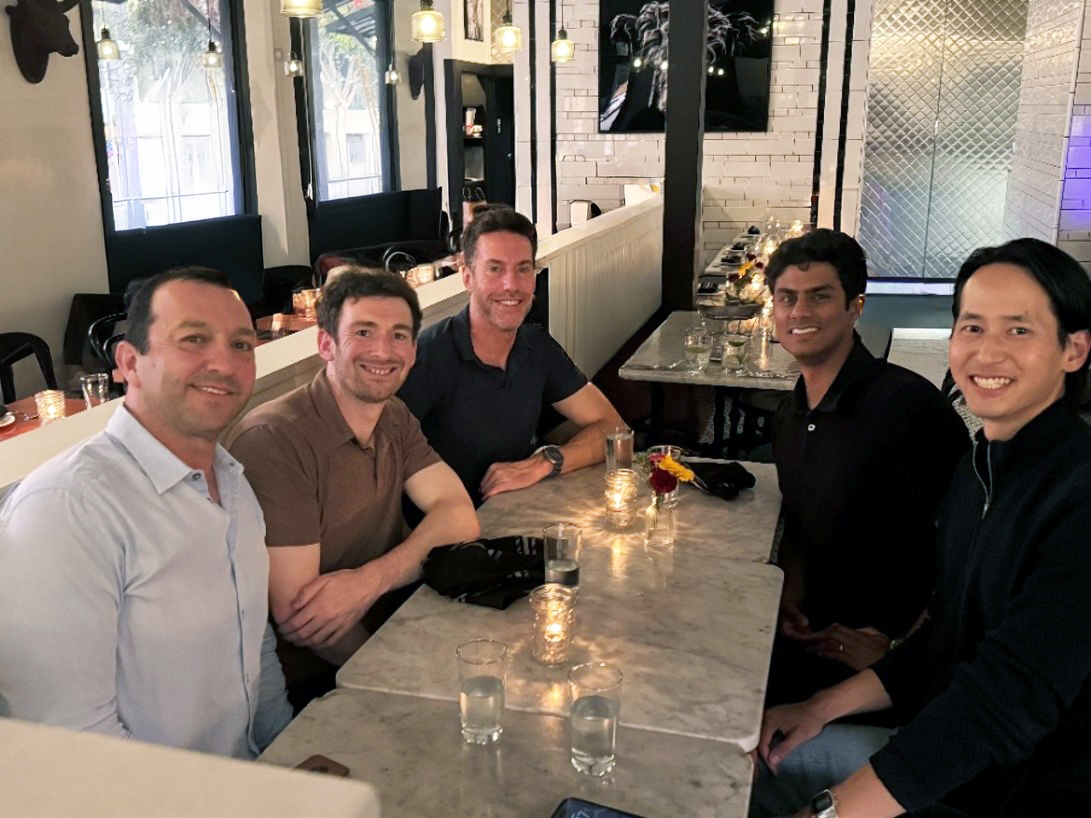
The DFJ Growth team at dinner with LangChain’s co-founders. From left to right are DFJ Growth venture partner Ramin Sayar, LangChain co-founder and CEO Harrison Chase, DFJ Growth partner Sam Fort, LangChain co-founder and CTO Ankush Gola, and DFJ Growth partner Kevin Tu.
